


Independent
ChargeRight
- Assessment Cost
- $12.99
- Time to Answer
- Minutes
- Shows the Math
- Yes, NEC 220.82
- No Install Upsell
- Yes
- PDF Report
- Yes
- NEC Compliant
- 220.82 Optional Method
- Master Electrician
- Yes (IBEW 369)
ChargeRight reads it differently. Built by an IBEW Master Electrician, not a sales channel.
ChargeRight runs the same NEC 220.82 math your electrician uses, for $12.99 instead of a $500 service call.
or enter a dealership code
For EV Dealerships
Offer ChargeRight to every buyer.
Stop losing deals to “will my house handle a charger?” answer it in 5 minutes.
New to you, new questions
Over 31,000 used EVs sell every month in the US[1]. Most buyers have no idea if their panel can handle a Level 2 charger.
A $12.99 NEC 220.82 assessment tells you exactly what you need, before you call an electrician.
Check Your Panel, $12.99Designed for homeowners who want clear answers before committing to electrical work.
ChargeRight uses the Optional Method load calculation trusted by licensed electricians for residential panels.
Get a PDF with your load breakdown, safe capacity, and charger sizing guidance.
Straight answers without the sales pressure, use it to plan, budget, or confirm quotes.
Same 2,400 sqft home. Same 200A panel. Same 48A Tesla charger. Two NEC methods. One says ‘upgrade required.’ The other says ‘you’re fine.’
Most homeowners getting EV charger quotes are told they need a panel upgrade. Most of them don't. This animation shows exactly why, using the same 2,400 sqft home, 200A panel, and 48A Tesla charger run through two different NEC calculation methods. One says 'upgrade required.' The other says 'you're fine.' ChargeRight shows you the honest math.
More explainers
Swipe through the rest of the library, every video shows the math, the loophole, or the thing your installer didn’t mention.

Snap a photo of your electrical panel for AI-powered analysis

Professional electrical load calculation using NEC demand factors

Professional report showing your capacity and recommendations
Full walkthrough: calculator → panel photo → NEC 220.82 report
5 things to check before hiring an electrician, from an IBEW Master Electrician.
No spam. Unsubscribe anytime.
Independent assessment
Independent assessment vs. installation brokers vs. local electricians. Swipe to see each side-by-side.
ChargeRight uses the same NEC 220.82 load calculation method that licensed electricians use. The difference? Results in minutes for $12.99, not weeks for $300.
$12.99
ChargeRight Assessment
Results in minutes. NEC 220.82 compliant.
$150–$300
Electrician Service Call
Wait days to weeks. Quality varies.
Not sure what a panel upgrade actually costs? We break down the 4 levels of electrical work so you know exactly what you need.
Most homeowners with 200A panels do NOT need a panel upgrade. A NEC 220.82 load calculation typically shows 40-60 amps of spare capacity, more than enough for a Level 2 charger. Based on NEC 220.82 calculations across typical US homes (median 2,000 sqft, gas heat, standard appliance mix), approximately 80% have sufficient spare capacity for a 40A Level 2 charger without a panel upgrade. Only about 20% of homes actually require panel work. ChargeRight's $12.99 assessment shows you the exact math before you commit to a $3,000-$5,000 upgrade.
EV charger installation costs $500-$6,000 depending on what you actually need. Most homeowners only need a circuit addition ($500-$1,500). A full service upgrade runs $2,000-$5,000+. The key is knowing which level applies to your home. A $12.99 load calculation can save you thousands by proving you don't need the expensive option.
A 32A charger adds ~25 miles of range per hour and is plenty for most drivers. You don't necessarily need a 48A charger. A smaller charger may let you skip a panel upgrade while still fully charging overnight. The ChargeRight calculator recommends the right size based on your driving habits and panel capacity.
Yes. ChargeRight uses NEC 220.82 (the Optional Method), the industry-standard calculation used by licensed electricians, and also compares against NEC 220.83 and the Standard Method. Final installation should always be verified by a licensed electrician per local code requirements.
NEC 220.82 is the industry-standard Optional Method for residential load calculations. It applies realistic demand factors (40% for loads over 10kVA) based on the fact that not all appliances run simultaneously. Other methods like the Standard Method (Part III) are more conservative, while 220.83 is specifically for adding loads to existing dwellings. All methods are shown in your results for comparison.
The 2026 NEC (effective in jurisdictions adopting it) makes significant changes: lighting load reduced from 3 to 2 VA/sqft, first demand tier reduced from 10kVA to 8kVA, and critically, EV chargers must now be calculated at 100% with no demand factor allowed. We include a 2026 preview in our comparison so you can plan ahead.
The Optional Method (220.82) applies a blanket 40% demand factor to loads over 10kVA, resulting in lower calculated loads. The Standard Method (Part III) applies demand factors to individual load categories and produces higher, more conservative results. For most residential EV assessments, 220.82 is appropriate and widely accepted by electricians and inspectors.
A clear PDF report with your load breakdown, recommended charger size, and next-step guidance you can share with an electrician.
Your inputs are only used to generate the report. ChargeRight does not sell your data, and you can contact support to remove it at any time.
No. ChargeRight is an online assessment tool that runs NEC 220.82 load calculations and provides a professional report you can share with YOUR local electrician. ChargeRight does not do installations or electrical work. It helps you know what you need before you call a contractor.
ChargeRight costs $12.99 for a full NEC 220.82 panel assessment with AI analysis and a professional PDF report. Compare that to a $150 to $300 electrician service call or a $3,000 to $6,000 installation quote from a referral network like Qmerit. You could save $2,000 to $5,000 by discovering you don't need a panel upgrade.
A professional PDF you can use to plan upgrades or share with your electrician.
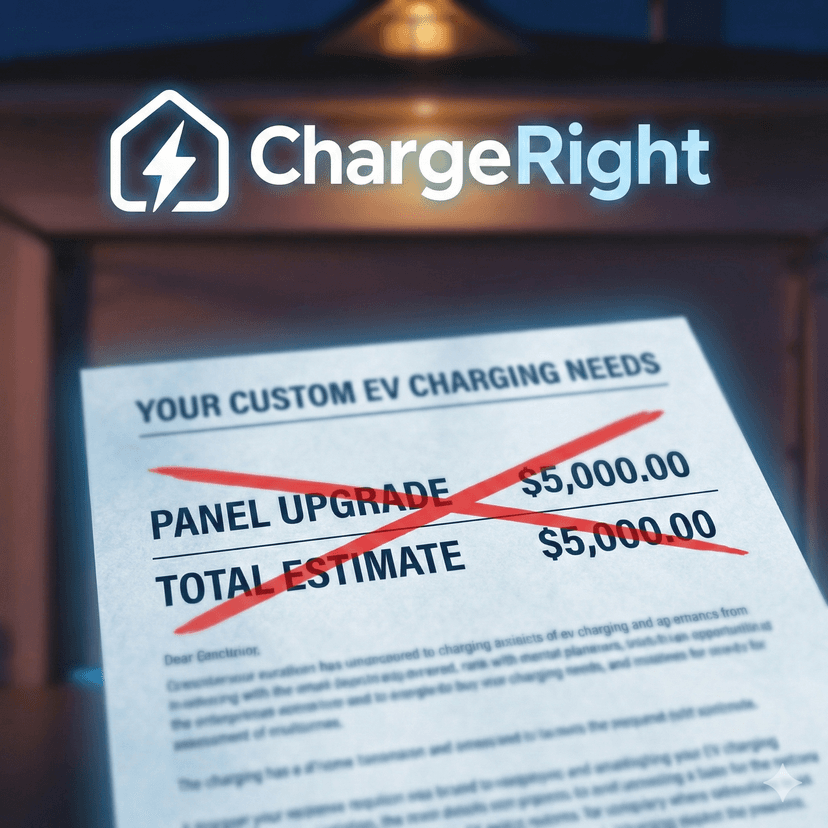
Sample Report
ChargeRight follows the Optional Method used by electricians to estimate residential load.
Square footage, major appliances, HVAC, water heater, and EV charging needs.
Apply NEC demand factors to reflect realistic usage and diversity.
Compare calculated load to safe panel capacity for a clear go/no‑go signal.
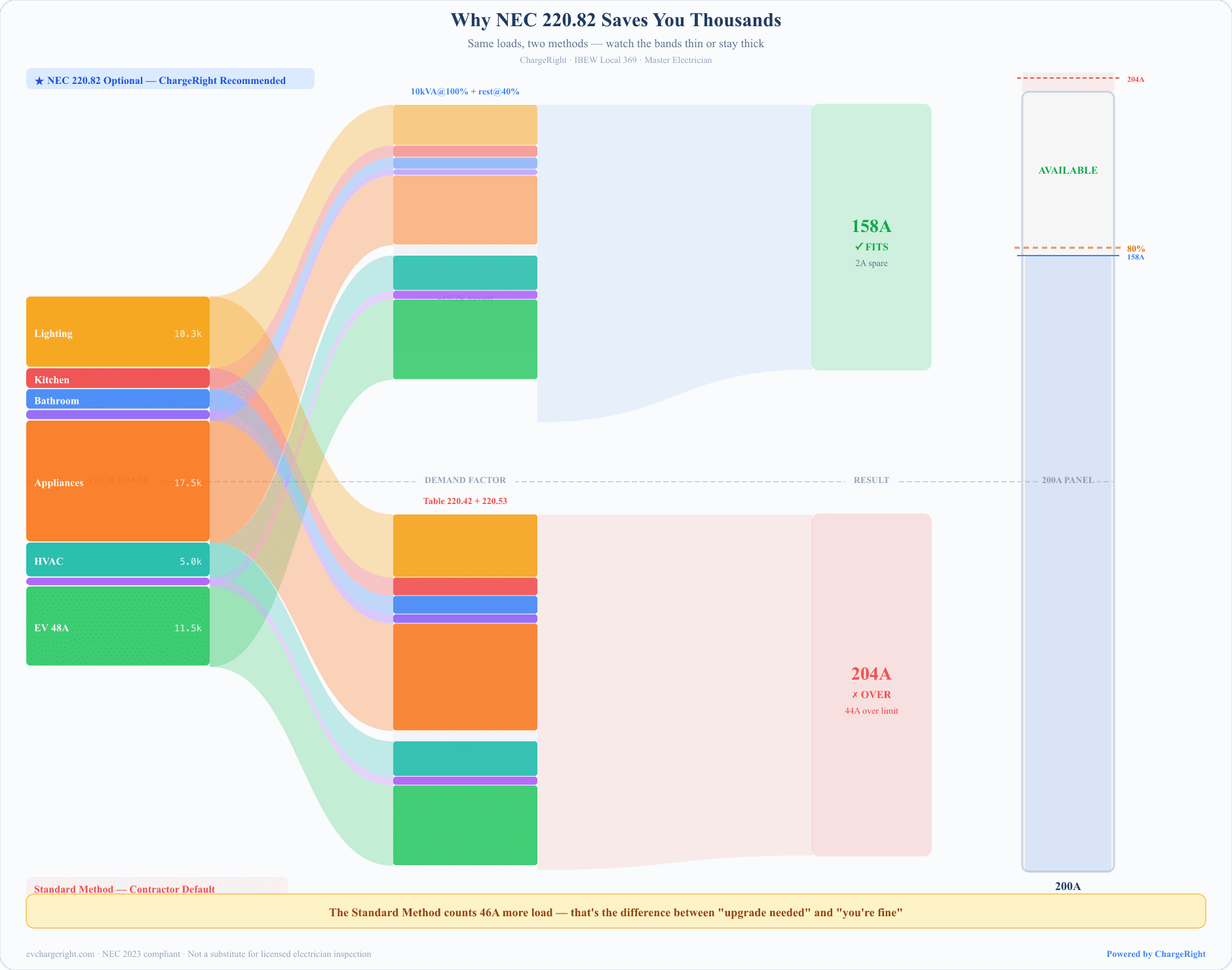
Same loads, two methods. Watch the bands thin or stay thick. That difference is $3,000.
Want the full step-by-step? Read our detailed NEC 220.82 walkthrough with real numbers.
Pick your situation
$12.99 for the same math your electrician charges $300+ for. Pick the path that fits.
Results in minutes · 30-day money-back guarantee · PDF report included
Social proof
Why people trust ChargeRight
The endorsements, the credentials, and the receipts, swipe through what got us here.
860,000+ views on X
When Mark Cuban posted ChargeRight on X, the response was thousands of likes, retweets, and bookmarks, all pointing at the same problem: opaque EV-install pricing.
IBEW Local 369 · EVITP Certified
Jason Walls is a Master Electrician, not a SaaS founder pretending to know panels. Every NEC calc reflects 10,000+ hours of residential field work.
5 NEC methods on every report
We don't hide behind one calc. ChargeRight runs 220.82, 220.83-A, 220.83-B, the Standard Method, and the 2026 NEC preview side by side.
$3,000 to $5,000 saved per home
For roughly 70% of 200A panels, the load math says you don't need a service upgrade. That's the spread we hand back to homeowners.