
Global new-vehicle sales · H1 2026
Gas-only cars below 50%.
I’m Jason, I’m an electrician, and I built ChargeRight. If this headline has you looking at a car that plugs in, the first thing I’d want to know is where it charges and what your house is already running.

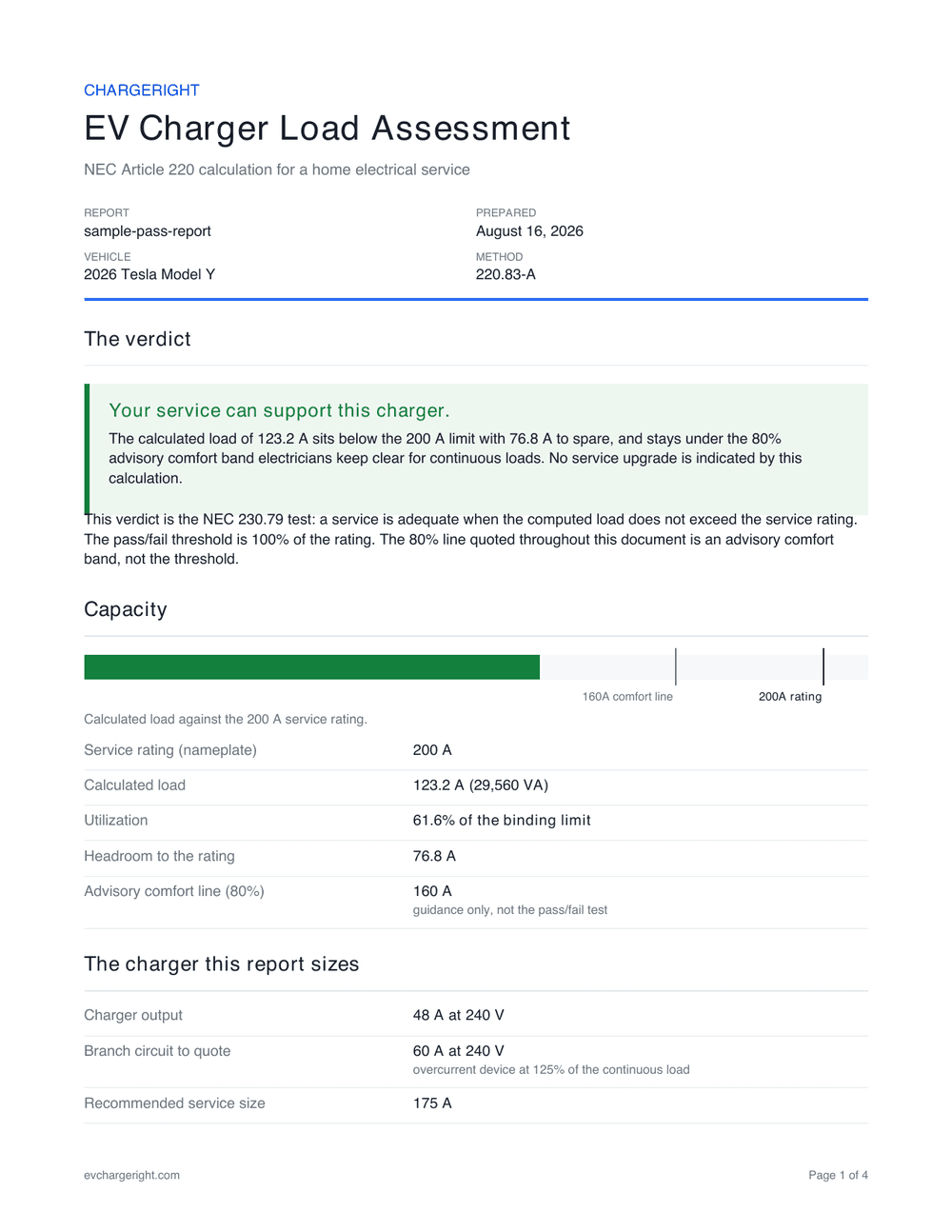
View the sample report
Which vehicles are in the sales figures?
GLOBAL · NEW SALES · H1 2026Select a category to see what it means for charging.
Gasoline-only
The category in the headline. It excludes the separately counted hybrids.
Dated snapshot from the report linked below. The combined remainder is approximate; its plug-in-hybrid share is unknown.
Source: Electrek, October 5, 2026, citing Mobility Global via Nikkei. We reviewed the report, not the underlying dataset. See the source notes.
Quick answer
What actually fell below half?
Gasoline-only vehicles were reported at 49% of global new-vehicle sales in the first half of 2026. The figure does not describe the US market or all cars on the road. It also does not mean battery-electric vehicles hold a majority. Read the reported sales figures.
Some hybrids plug in and some don’t.
Check the exact model before you buy anything for the garage. A conventional hybrid uses an engine and an electric motor, and recharges without plugging into an external power source. A plug-in hybrid adds external charging. A battery-electric car relies on its battery. Check the exact vehicle before shopping for charging equipment. The Department of Energy explains these vehicle types.
| Vehicle type | Charging connection |
|---|---|
| Conventional hybrid (HEV) | Does not plug in. |
| Plug-in hybrid (PHEV) | Can charge externally. Follow the vehicle’s guidance. |
| Battery-electric (BEV) | Plugs in to recharge its battery. |
What should you check next?
Choose your situation for a planning checklist. This does not calculate electrical capacity or approve an installation.
Ask for the load calculation
Ask your electrician for the load calculation on your house before anyone quotes a panel upgrade. Plan around the vehicle, your driving and the home’s existing loads.
Start my ChargeRight pre-assessmentSelections stay on this page and reset when you leave.
Does your home need a panel upgrade for an EV charger?
What matters is what the house already pulls (the range, the dryer, the AC, the water heater) and what the charger adds on top. That’s a load calculation. If a quote says you need a bigger panel, that calculation is what should back it up, so ask to see it.
I built ChargeRight to help homeowners bring a load pre-assessment to their electrician. You should be able to ask what the home already uses, what the proposed charger adds and what supports the recommendation in the quote.
The electrician still needs to check the site, equipment, wiring route, condition and local requirements. An online report does not approve an installation. Read how the assessment works and its scope and limitations.
Questions behind the headline
Have gas cars fallen below 50% of global sales?
Gasoline-only vehicles accounted for 49% of global new-vehicle sales in H1 2026, according to Electrek’s report of Mobility Global data first reported by Nikkei. This is a six-month sales measure, not the share of vehicles already on the road.
Does that mean most new cars are fully electric?
No. Battery-electric vehicles were reported at 17%. Conventional hybrids were counted separately, and the remaining categories include vehicles with combustion engines. “Not gasoline-only” does not mean “fully electric.”
Does a hybrid need a home charger?
A conventional hybrid does not plug in. A plug-in hybrid can charge from an external power source. Check the exact vehicle type and manufacturer’s charging guidance before planning equipment.
Does buying an EV automatically mean I need a panel upgrade?
No. An upgrade decision depends on the home’s existing electrical loads, the proposed charging load and the site. A load pre-assessment can support that discussion; the electrician must verify the installation and local requirements.
What does ChargeRight do before an EV charger installation?
ChargeRight provides a household electrical load pre-assessment to discuss with your electrician. It helps put the load math into the planning conversation. It does not replace a site inspection, installation design, permit or approval.
Sources and what we checked
- Fred Lambert, Electrek, October 5, 2026. Secondary report of Mobility Global data, attributed to Nikkei’s original report. The original article and raw dataset were not independently accessible during our review.
- US Department of Energy: Hybrid Electric Vehicles. Reference for how conventional hybrids work and why they do not plug in. Its vehicle-type overview explains BEVs and plug-in hybrids.
- Chart shares follow the cited report. The combined remainder is calculated from its rounded categories; it cannot identify plug-in-hybrid share. This article is a dated snapshot, not a live sales tracker.
Reviewed October 15, 2026. This guide interprets a global market headline for people considering home charging. The planning tool is educational and makes no electrical capacity decision.